

Why learning feels so hard
Understanding the simple model of memory helps explain why many children become frustrated, lose confidence and begin to believe they don’t enjoy learning.

Parents often describe the same pattern. A child who is naturally curious and eager to explore the world becomes reluctant to read, avoids maths homework or insists they “hate school”. It is tempting to interpret this as a lack of motivation. More often, it reflects something much simpler: learning is mentally demanding.
One of the most useful ways of understanding this comes from the simple model of memory.
When children encounter something new, they think about it using working memory. This is the part of memory responsible for conscious thought, but it has a very limited capacity. It can only process a small amount of information at any one time.
Knowledge that has already been learnt is stored in long-term memory. Unlike working memory, long-term memory has an enormous capacity. Every word a child knows, every number fact they can recall and every concept they understand is stored there.
Learning occurs when new information is successfully processed in working memory and connected to knowledge already stored in long-term memory. Every time children remember something, they are able to draw on that knowledge the next time they encounter it. As their knowledge grows, learning becomes easier because working memory has fewer new things to process.
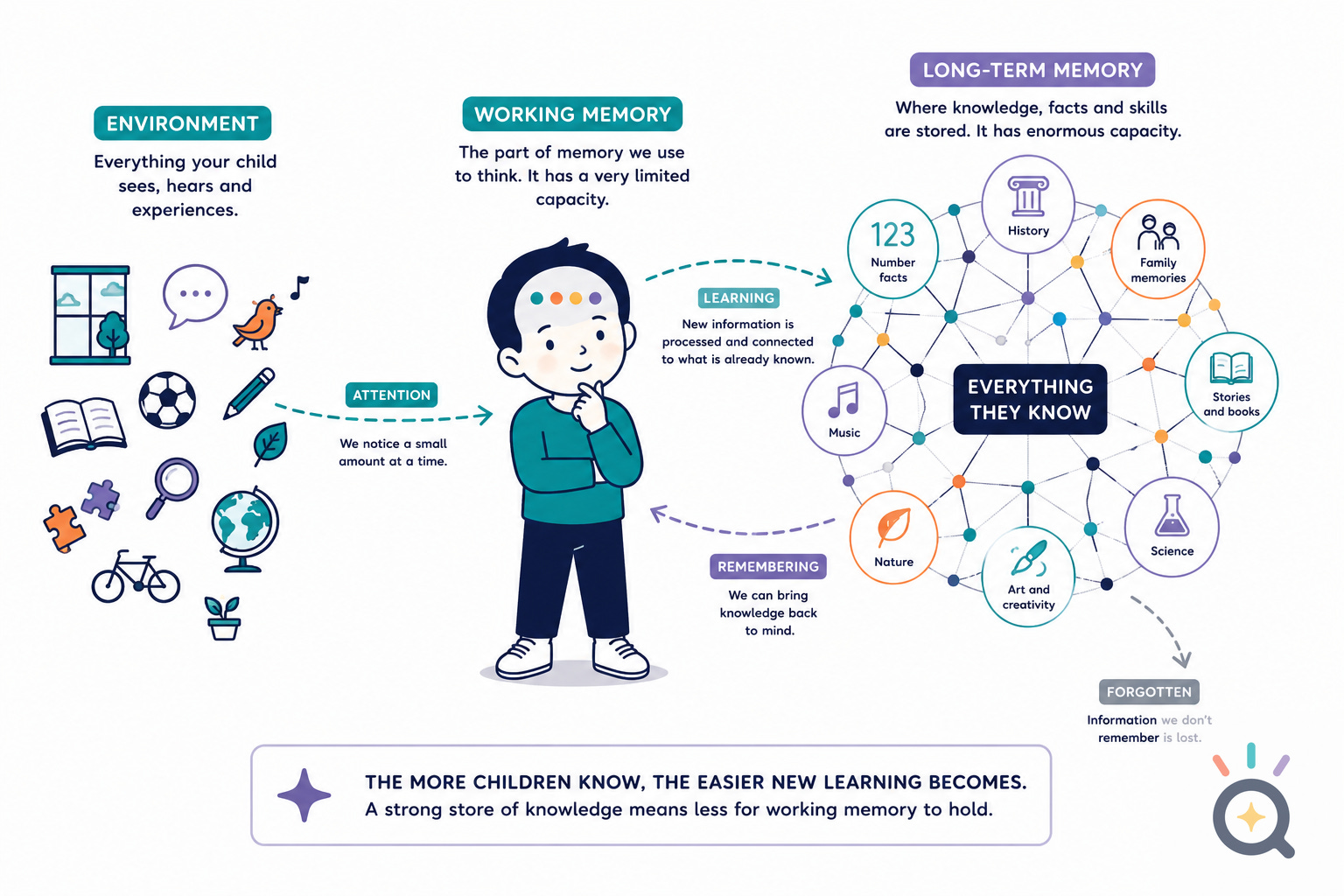
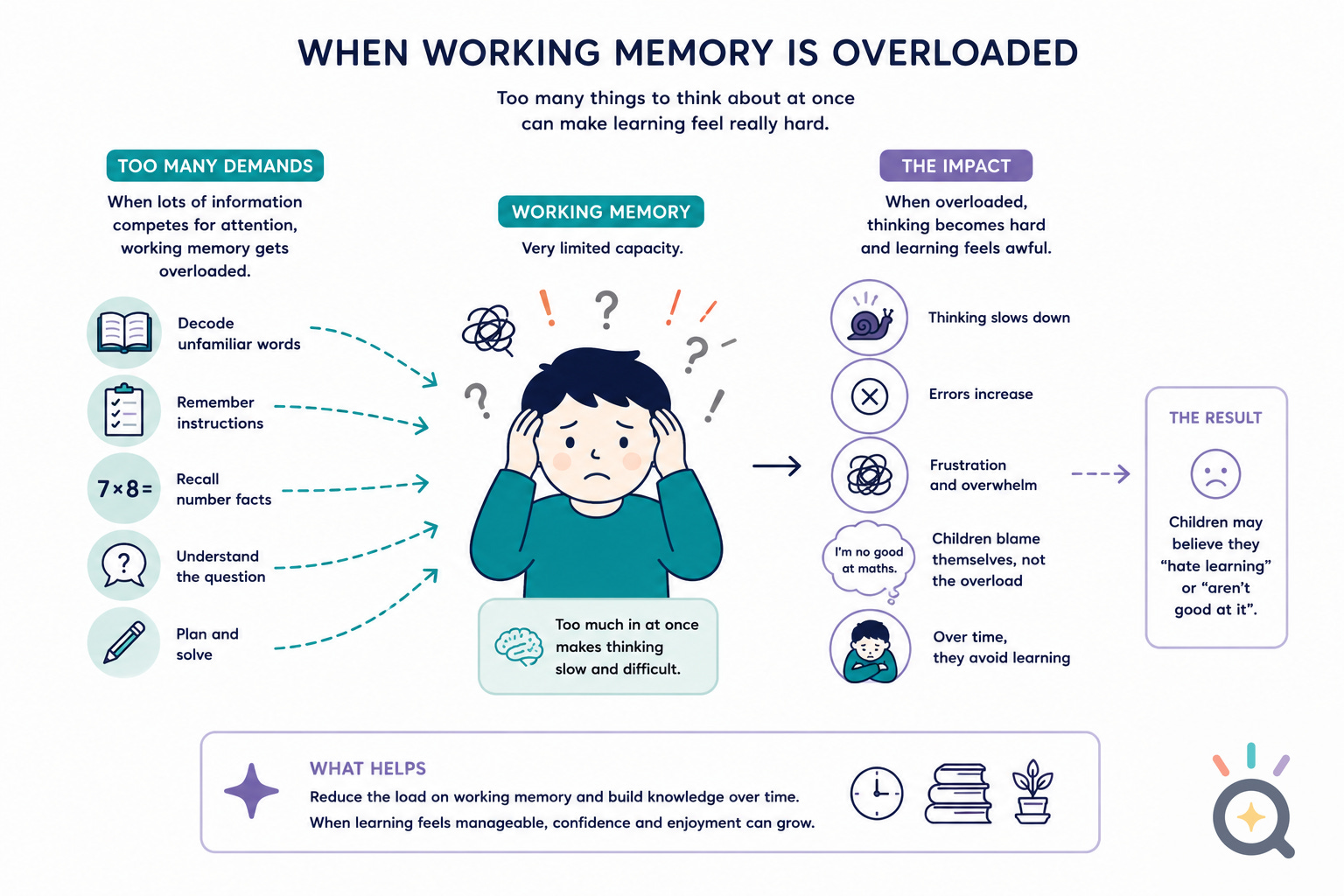
The difficulty is that working memory becomes overloaded very quickly. A child may be trying to decode unfamiliar words, remember instructions, recall number facts and work out what the question is asking simultaneously. When too many demands compete for limited mental capacity, thinking becomes slow, errors increase and learning begins to feel frustrating.
Children rarely describe this as cognitive overload. Instead, they conclude that they are “bad at maths”, “not a good reader” or that they simply “hate learning”. What they are often describing is the experience of sustained mental effort. When learning feels difficult day after day, it is understandable that some children begin to avoid it.
Understanding how memory works changes the way we think about supporting learning at home. Rather than assuming children need more motivation, it encourages us to think about how we can gradually build the knowledge that makes learning easier over time.
What this means at home
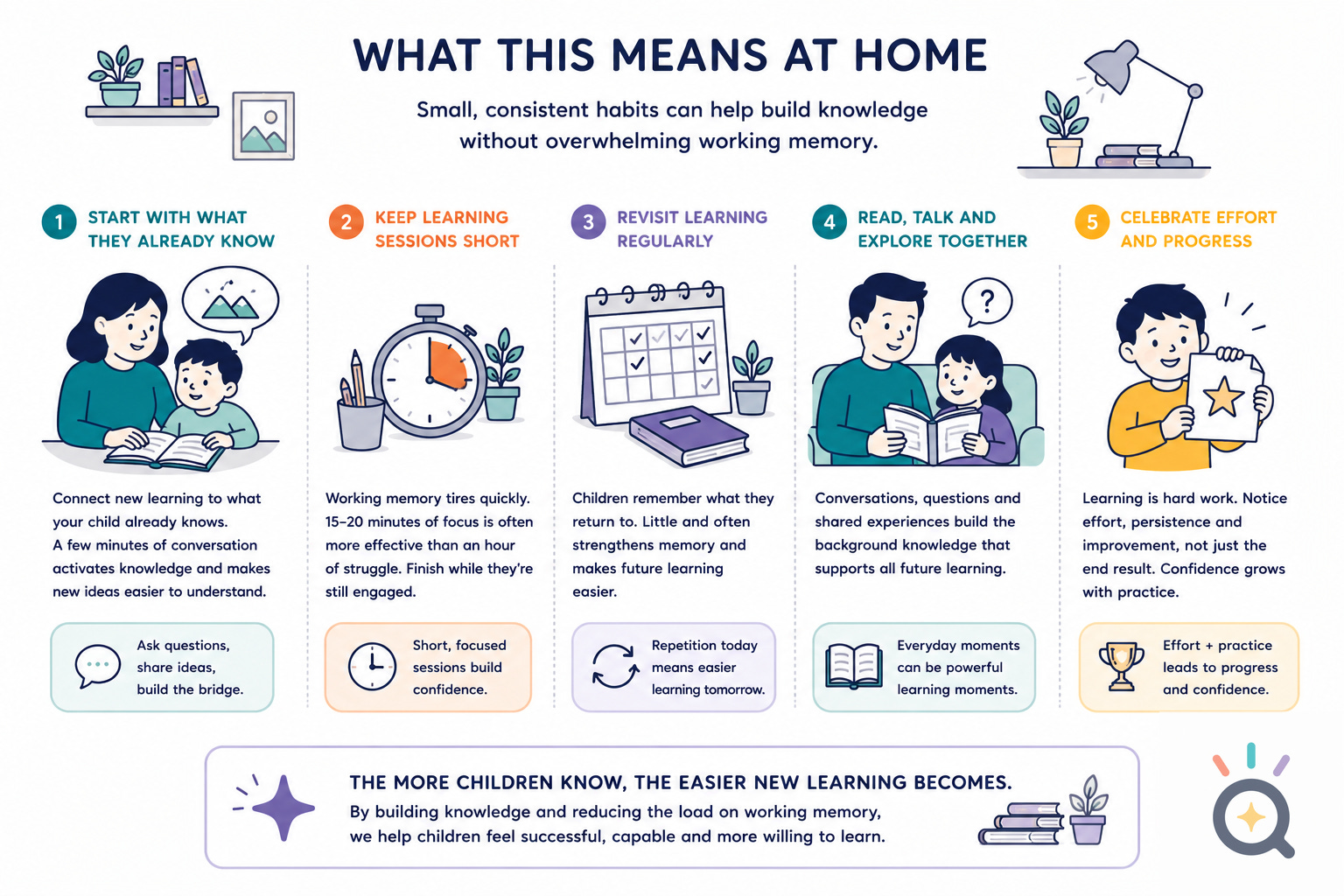
You do not need to recreate school at your kitchen table. Small, consistent habits can have a remarkable impact because they help children build knowledge without overwhelming their working memory.
Start with what your child already knows
New learning is easier when it connects to existing knowledge. Before reading a new book or exploring a new topic, spend a few minutes talking about what your child already knows. This activates knowledge in long-term memory and makes it easier to understand new ideas.
Keep learning sessions short
Working memory tires quickly. Fifteen or twenty minutes of focused learning is often more effective than an hour spent battling through frustration. Finishing while your child is still engaged makes it more likely they will return to learning the next day with confidence.
Revisit learning regularly
Children remember what they return to. Revisiting vocabulary, number facts, spellings or previous reading helps strengthen long-term memory and reduces the effort required in the future. Little and often is usually more effective than long, infrequent sessions.
Read, talk and explore together
Every conversation builds knowledge. Reading aloud, discussing documentaries, answering curious questions or talking about something you’ve seen on a walk all help children develop the background knowledge that supports future learning. These moments may not feel like lessons, but they are an important part of how children learn.
Celebrate effort and progress
Learning is meant to feel challenging because thinking is hard work. Rather than focusing only on whether your child gets the right answer, notice the effort they put into concentrating, remembering and solving problems. Confidence grows when children recognise that becoming better at something is the result of practising, thinking and learning over time.
Children do not need learning to be effortless. They need opportunities to build knowledge, experience success and see that difficult things become easier with practice.
That is the idea behind Findory. The activities are designed to be short enough to fit into busy family life, practical enough to use straight away and grounded in what we know about how children learn. Together, they help children build the knowledge that makes future learning feel a little easier.