
There is a lot competing for our attention as parents, from the school emails to read, lunches to make, uniforms to find and appointments to remember, to the apparently endless number of water bottles that need locating just as somebody is supposed to be leaving the house. There are sports and music lessons, homework, dinner, work and the general business of keeping a family moving. Somewhere amongst all of that, we are also supposed to be thinking seriously about our children’s futures and working out whether we are doing enough to prepare them for whatever comes next.
Working out what our children might actually need from us feels particularly difficult when the world they are growing up in is changing extraordinarily quickly, and we hear constantly about the things they will apparently need to thrive in it: creativity, adaptability, critical thinking, collaboration, digital literacy, coding, entrepreneurship and, increasingly, the ability to work alongside artificial intelligence. Much of that may turn out to be right, but I don’t know exactly what my own children will be doing in twenty years and I am increasingly suspicious of anyone who claims that they do.
Beneath all this uncertainty, I find it reassuring that there are some things we can be reasonably confident will continue to matter. Whatever our children eventually choose to do, being able to read well, write clearly, understand number, reason mathematically and continue learning will give them choices. English and mathematics are not simply things children need to get through school, perform well in tests or prepare themselves for something else; they contain fascinating ideas, stories, patterns, problems and ways of understanding the world that are worth discovering and enjoying in their own right. At the same time, strong literacy and numeracy allow us to understand, communicate and participate more fully in the world around us. In a future that is difficult to predict, giving our children really strong foundations in both feels like one of the more useful things we can do.
Much of the knowledge that makes those strong foundations possible begins to accumulate during the primary years, when children are learning things they will draw upon again and again for the rest of their education and well beyond it. They learn how our number system works, the number facts and multiplication facts that make later mathematics easier, how to decode words and then read increasingly sophisticated texts, the vocabulary that helps them understand those texts, and the foundations of expressing themselves clearly in writing. None of this happens instantly. Learning something well takes thought, effort and practice, and our memories are not particularly obliging: something understood perfectly on Tuesday can apparently have vanished by Friday. Knowledge becomes more secure because we encounter it, think about it, retrieve it and use it again over time.
Even in excellent schools, finding enough time for every child to revisit and practise everything that matters is difficult when classrooms are busy places and teachers are balancing the needs of a whole class alongside the many competing demands of a school day. This is where I think home can offer something rather special. I don’t mean recreating school at the kitchen table, filling evenings with worksheets or assuming that the answer must be hours of tutoring. I mean making occasional, deliberate space for learning within ordinary family life.
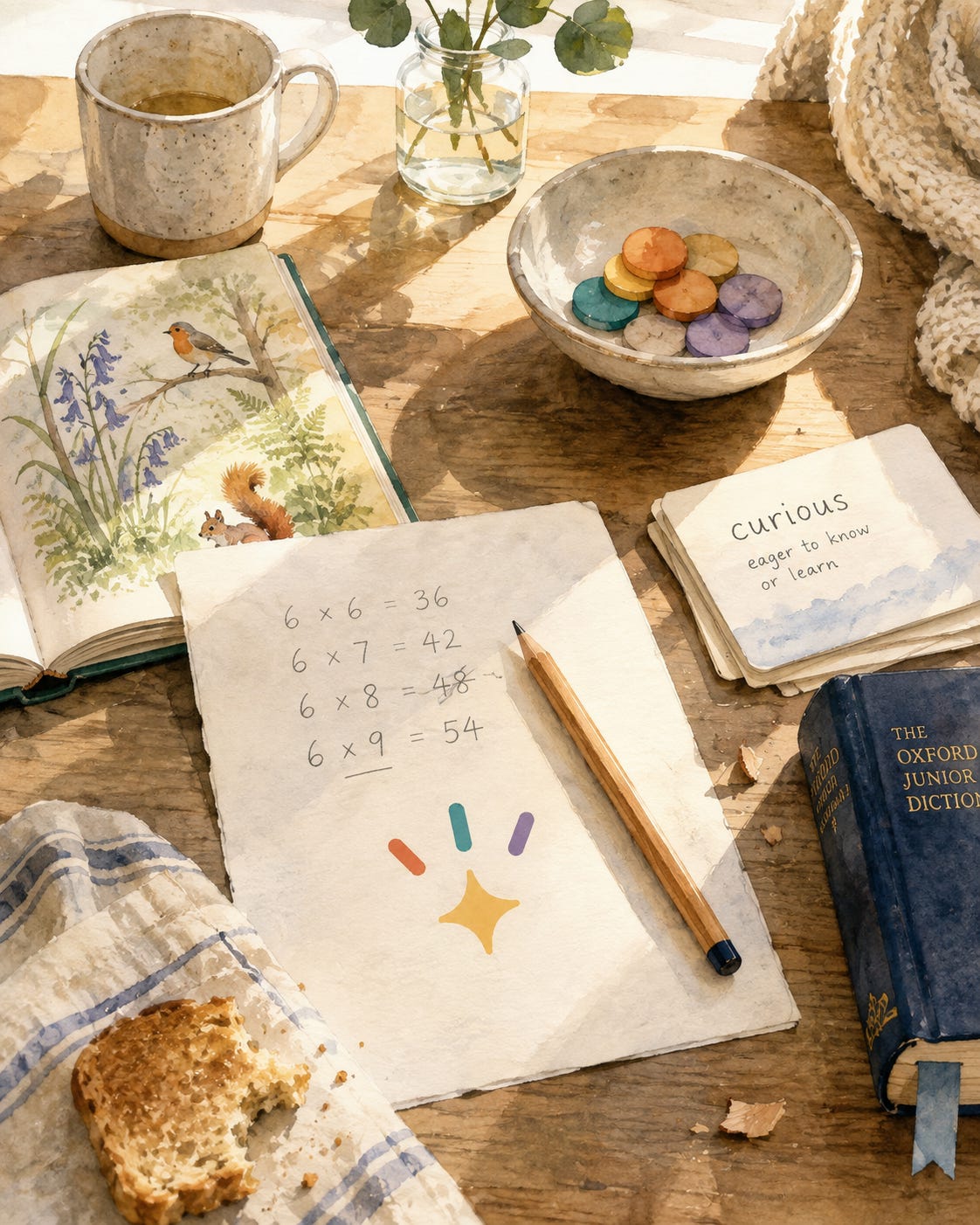
Some of the loveliest opportunities to do this are also the simplest: ten minutes on the sofa with a book, a quick-fire multiplication game while dinner cooks, looking up an unfamiliar word and competing to put it into the most ridiculous sentence, trying to remember yesterday’s five spellings, or finding out why flamingos are pink because somebody asked at breakfast and none of you knew. Some of these moments will be lovely and some will involve a child insisting with absolute certainty that seven times eight is forty-eight, because learning is hard sometimes and I don’t think we should pretend otherwise. Children will get things wrong, become frustrated and occasionally need to practise something more times than either they or we would ideally like.
The warmth of learning together matters most, I think, when something isn’t immediately easy, because warm learning isn’t about removing difficulty but about experiencing it somewhere safe, alongside someone who believes you can get there. There is something lovely about sitting together, talking and thinking, getting something wrong, having another go and eventually noticing that the thing which felt impossibly difficult last week has become manageable. The enjoyment doesn’t always have to come from making the activity entertaining; sometimes it comes from the learning itself, and from that very human satisfaction of realising that you know something now that you didn’t know before.
Protecting these small pockets of shared time can also give us something rather lovely as parents, particularly during primary school when family life seems to move at an alarming speed and an entire evening can disappear into logistics. Ten minutes when the work laptop disappears, a book comes out or everyone becomes unexpectedly invested in finding the capital of Mongolia is not only educational. It is time spent paying attention to the same thing, talking to one another and being curious together. Learning doesn’t have to sit outside family life as another task to complete; at its best, it can become part of the texture of it.
This idea of making worthwhile learning easier to weave into ordinary family life is part of what sits behind Findory, where we are quietly building tools to help parents understand what matters most in primary English and mathematics, work out where a little extra practice might make a difference and use small amounts of time well. I want to take some of the guesswork away, because parents already have quite enough to think about. Findory isn’t quite ready to share yet, but if you’re reading this, you are here very early. Thank you for finding us. You’ll be among the first to see what we’ve been working on.
Perhaps the little secret worth holding onto while we are getting ready is that you don’t have to do everything, predict the future, optimise every afternoon or turn your home into a classroom to make a meaningful difference to your child’s learning. Find ten minutes every now and then, read something together, learn an interesting fact, look up a word nobody knows or practise the six times table. Give your child the experience of finding something difficult, staying with it and discovering that they can learn it, while enjoying the small pleasure of being there alongside them when they do.
When none of us can offer our children certainty about the world they will inherit, giving them strong foundations, keeping as many possibilities open as we can and making some lovely memories together along the way feels like a pretty good place to start.
L x