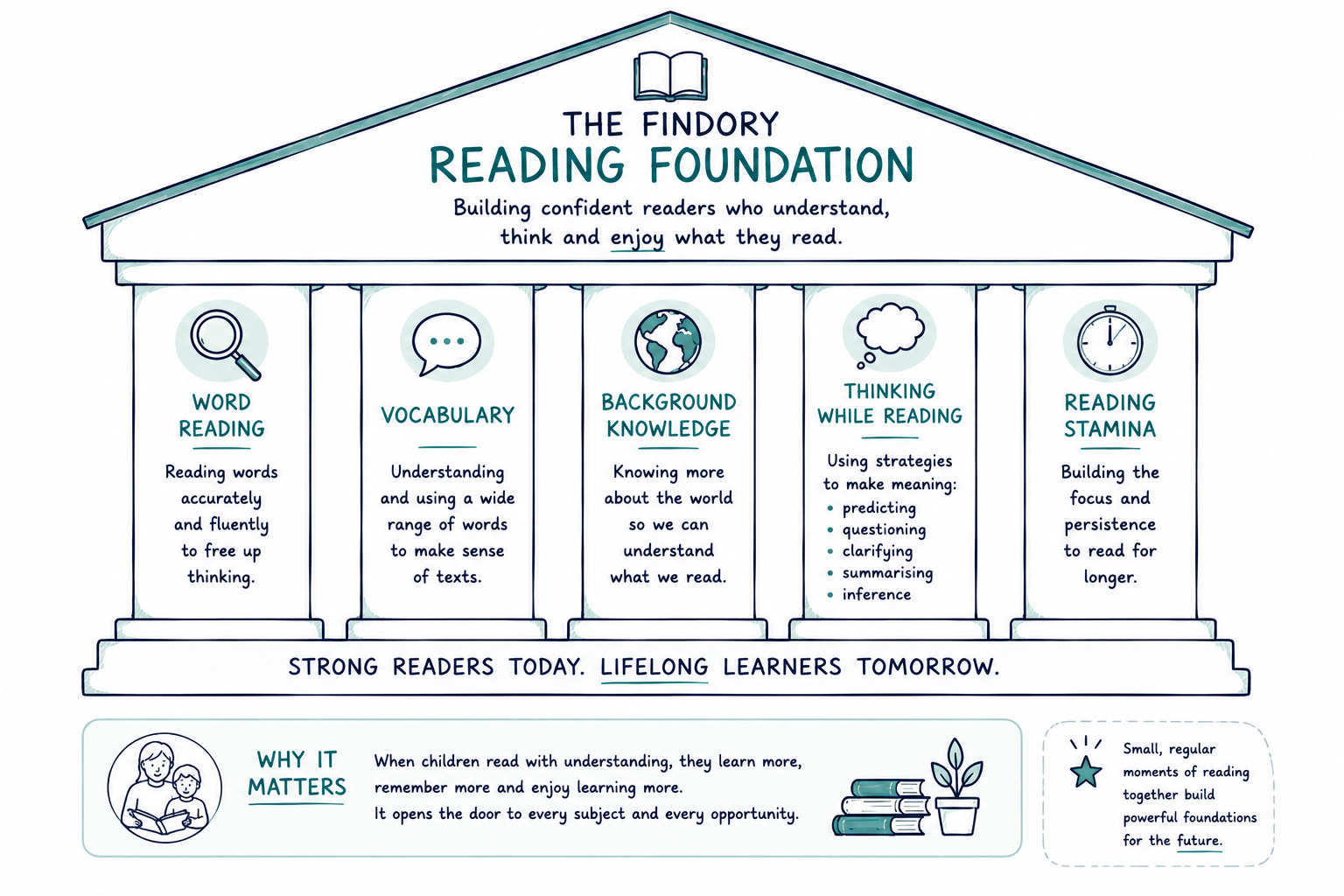
The Findory Reading Foundation
Why reading is the key that unlocks every other area of learning.

If I could only help a child strengthen one area of learning, it would be their reading.
Not because reading is more important than mathematics, science or history, but because it opens the door to all of them.
Every day at school, children are expected to read instructions, solve word problems, understand scientific explanations, interpret historical sources and make sense of increasingly complex texts. As they move through primary school, they spend less time learning how to read and much more time reading to learn. Reading therefore becomes more than another subject on the timetable; it becomes the route through which much of the curriculum is understood.
This is one reason why children’s reading comprehension at the end of primary school is such a strong predictor of future educational success. Children who understand what they read are better able to learn independently, build new knowledge and engage with increasingly demanding ideas. Strong reading is also associated with better outcomes beyond school, influencing opportunities for further study, employment and participation in wider society.
For Findory, reading is therefore the most important place to begin.
The Reading Foundation
Reading is sometimes spoken about as though it were one thing. In reality, understanding a text depends on several closely connected foundations working together.
The Findory Reading Foundation rests on five pillars: word reading, vocabulary, background knowledge, thinking while reading and reading stamina. Each supports the others. A child with fluent word reading has more attention available for understanding. A child with a rich vocabulary understands more of what they read. A child with broad background knowledge makes more connections. Thoughtful reading helps children construct meaning, while reading stamina allows them to sustain that thinking over longer texts.
None of these foundations sits in isolation. Together, they help children become confident readers who understand, enjoy and learn from what they read.
Word reading
Everything begins with word reading.
Word reading is a child’s ability to read words accurately and fluently. Accuracy means reading the correct words. Fluency means reading them smoothly, automatically and with appropriate expression.
This matters because of working memory.
Working memory is where we do our thinking, but it has a limited capacity. If a child has to concentrate on decoding every unfamiliar word, much of that capacity is used simply working out what the words say. There is then less attention available to understand ideas, make connections or enjoy the text.
As word reading becomes increasingly fluent, decoding requires less conscious effort. Working memory is freed to focus on meaning instead.
Word reading is therefore not the purpose of reading, but it is an essential foundation beneath it.
Vocabulary
Children cannot fully understand a text if too many of its words are unfamiliar.
Vocabulary is one of the strongest foundations for reading comprehension because every new word helps children make sense of increasingly complex ideas. A richer vocabulary also supports learning well beyond English. Whether children are reading about evaporation in science, democracy in history or equivalent fractions in mathematics, understanding the vocabulary makes understanding the lesson much easier.
Vocabulary grows through wide reading, conversation and repeated encounters with words in meaningful contexts. Pausing to discuss an unfamiliar word, exploring its meaning and returning to it later can make a remarkable difference over time.
Background knowledge
Reading also depends on what children already know.
Imagine reading an article about volcanoes. If you already understand ideas such as lava, magma, eruptions and the Earth’s crust, the article will make sense very quickly. If those ideas are completely new, understanding becomes much harder.
This is why reading widely is so valuable. Books, articles, documentaries, conversations and experiences all add to the store of knowledge children can draw upon when they encounter a new text. As that knowledge grows, it becomes easier to understand and remember new information.
Knowledge really does build knowledge.
Thinking while reading
Strong readers remain mentally active as they read.
They notice when something does not quite make sense. They pause to clarify unfamiliar ideas. They make connections with things they already know. They summarise important information and infer what the author has suggested without stating directly.
These are not simply techniques for answering comprehension questions. They are the ordinary habits involved in making meaning from a text, and they often develop through thoughtful conversations with adults while reading together.
Reading stamina
Finally, children need the ability to stay with a text.
Longer stories and increasingly complex non-fiction require concentration, persistence and sustained thinking. Like physical stamina, reading stamina develops gradually through regular reading.
Twenty enjoyable minutes spent reading together several times each week will almost always have a greater impact than occasional marathon sessions. As children become more fluent and knowledgeable, sustaining attention becomes easier because reading itself requires less effort.
Findory Challenge
The Reading Foundation brings together several connected elements, but one of the quickest ways to help children experience success is by strengthening word reading. As reading becomes more fluent, children have more attention available to think about meaning.
Choose a short passage of around 150–250 words. You can use the passage below or simply choose a page from your child’s current reading book.
Could you survive on Mars?
Mars is often called Earth’s neighbour because it is the planet most similar to our own. Even so, it would be an extremely difficult place for humans to live. The atmosphere is far too thin to breathe, temperatures can fall below minus 100 degrees Celsius and enormous dust storms sometimes sweep across the planet for weeks.
Astronauts would need specially designed habitats to protect them from freezing temperatures and harmful radiation. They would also need to grow food, recycle water and produce oxygen because there are no supermarkets, rivers or forests on Mars.
Despite these challenges, scientists continue to study Mars carefully. Robotic rovers have travelled across its rocky surface, collecting information about its geology and searching for evidence that liquid water once existed there. Many scientists believe that understanding Mars may help us learn more about the history of our own planet and whether life could exist elsewhere in the universe.
Step 1: Spot the tricky words
Before your child begins reading, spend a minute or two scanning the passage together.
Look for any words that may be difficult to decode or whose meaning may be unfamiliar. Practise reading these words together and talk about what they mean before reading the passage.
Some examples from today’s passage might include:
atmosphere
extremely
temperatures
habitats
radiation
recycle
geology
evidence
This short preparation removes some of the barriers before reading begins and helps children approach the passage with greater confidence.
Step 2: Read the passage
Ask your child to read the passage aloud and time the attempt.
Read the same passage a maximum of three times, timing each reading.
Most children will become noticeably smoother and quicker because they no longer have to work so hard to decode every word.
The aim is to compare each attempt with the one before and celebrate the improvement. Seeing the reading time reduce is a tangible reminder that progress is already happening. As reading becomes more fluent, the brain can spend less energy recognising words and more energy understanding the text.
This simple activity can be repeated using almost any page from your child’s own reading book.
Step 3: Go a little further
Once the passage feels familiar, use three questions to move from fluent reading to thoughtful reading.
Clarify
Why would astronauts need to produce their own oxygen on Mars?
Summarise
Can you explain the passage in two or three sentences?
Infer
Why do you think scientists continue to explore Mars even though it would be extremely difficult for humans to live there?
Word reading is only one pillar of the Reading Foundation, but it provides a strong place to begin. As reading becomes more fluent, children have more opportunity to think, question, connect ideas and, ultimately, enjoy what they are reading. Over time, we’ll continue exploring the other foundations that help children become confident readers who understand the world through what they read.