The Findory Philosophy
Why we don’t recreate school at home - and what we choose to do instead.

Every parent wants to help their child succeed at school.
We read together, help with homework, practise spellings, buy revision books and search for activities online. We do these things because we care deeply about our children and want to give them every opportunity to flourish.
Yet supporting learning at home can sometimes feel overwhelming. Should you revisit today’s maths lesson? Practise handwriting? Read another chapter? Print worksheets? Watch an educational video? The internet offers an endless stream of advice, but very little of it answers the question that matters most:
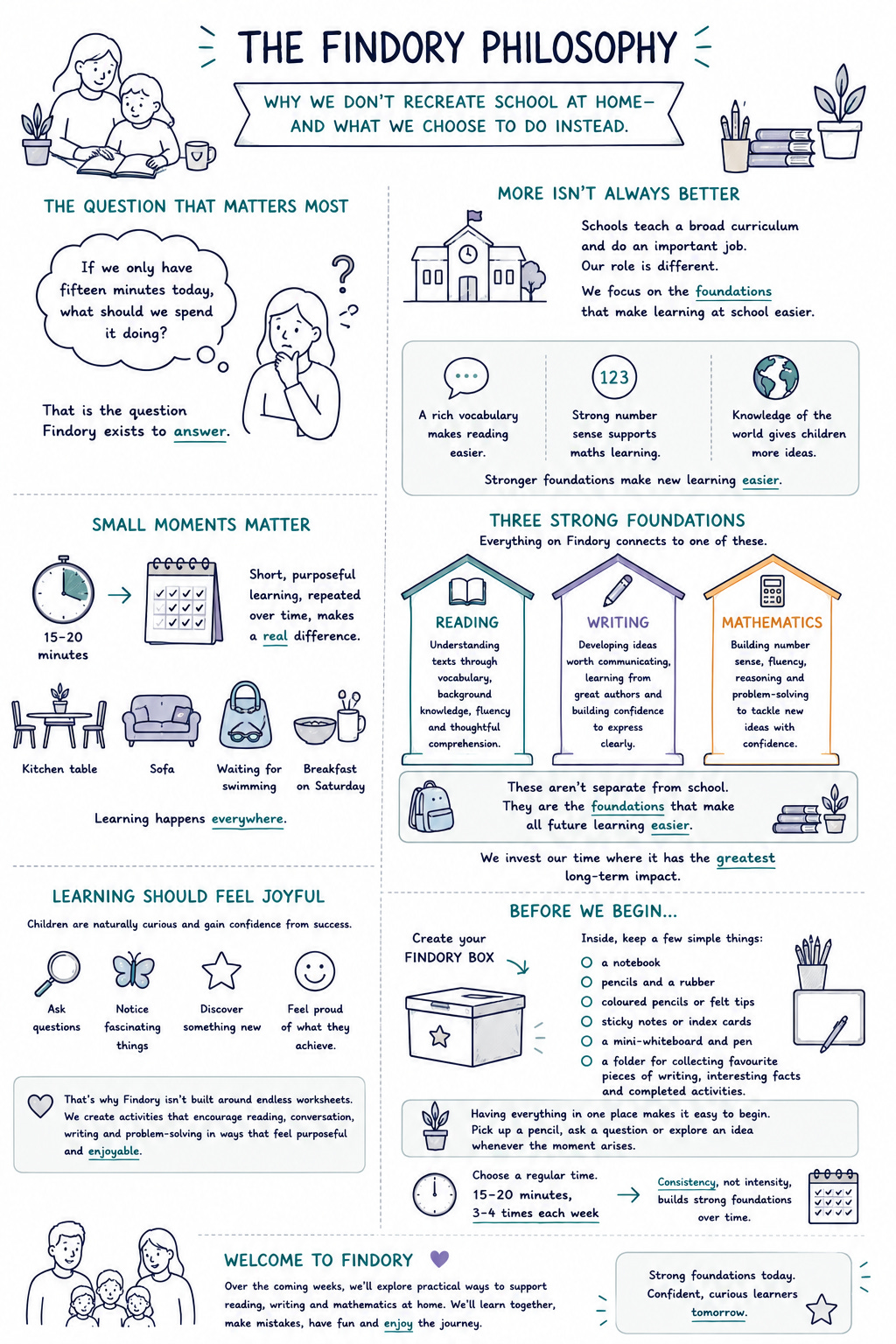
If we only have fifteen minutes today, what should we spend it doing?
That is the question Findory exists to answer.
More isn’t always better
At Findory, we don’t believe children need more school when they get home. Schools already have an important job to do. They teach a broad curriculum, introduce new concepts, assess understanding and help children make progress across many different subjects. Our role is different.
Rather than trying to recreate the curriculum, we focus on strengthening the foundations that make learning at school easier. Some aspects of learning have far greater impact than others. A child with a broad vocabulary finds reading easier. A child with secure number sense learns new mathematical ideas more readily. A child with rich knowledge of the world has more ideas to think about, discuss and write about. When these foundations become stronger, new learning becomes easier too.
Small moments matter
Families are busy. Between work, school, clubs, homework and everything else that comes with family life, very few people have hours to dedicate to extra learning. The good news is that they don’t need to.
Research tells us that learning is built over time through repeated opportunities to think, remember, practise and connect new ideas to what we already know. That means short, purposeful learning can be remarkably powerful. Fifteen or twenty focused minutes, completed consistently over many months, can make a meaningful difference.
Findory has been designed with real family life in mind. Our activities can be completed around the kitchen table, on the sofa, while waiting for swimming lessons to finish or over breakfast on a Saturday morning. Learning doesn’t only happen in classrooms, and some of the most valuable learning happens in everyday conversations and shared experiences.
Three strong foundations
Everything you find on Findory connects to one of three foundations.
Reading helps children understand increasingly complex texts by developing vocabulary, background knowledge, reading fluency and thoughtful comprehension.
Writing helps children develop ideas worth communicating, learn from great authors and build the confidence to express themselves clearly.
Mathematics helps children develop secure number sense, fluency, reasoning and problem-solving so they can tackle new mathematical ideas with confidence.
These aren’t separate from what children learn at school. They are the foundations that make all future learning easier. Every activity, article and resource on Findory has been designed with these foundations in mind so that, whatever you’re doing together, you’re investing your time where it will have the greatest long-term impact.
Learning should feel joyful
Learning is hard work, but it shouldn’t feel joyless.
Children are naturally curious. They ask questions, notice fascinating things and delight in discovering something they didn’t know yesterday. They also gain confidence from success. Finishing a book that once felt difficult, solving a maths problem independently or writing something they’re proud of all reinforce the belief that they are capable learners.
That is why Findory isn’t built around endless worksheets. Instead, you’ll find activities that encourage reading, conversation, writing and problem-solving in ways that feel purposeful and enjoyable. Our aim isn’t simply to help children complete more work; it’s to help them become more confident, curious and capable learners.
Before we begin...
One of the best things you can do is create a small space for learning at home. It doesn’t need to be a dedicated room or a beautifully organised study. A box, basket or drawer is more than enough.
We’ll call it your Findory Box.
Inside, keep a few simple things ready to use:
a notebook
pencils and a rubber
coloured pencils or felt tips
sticky notes or index cards
a mini-whiteboard and pen
a folder for collecting favourite pieces of writing, interesting facts and completed activities.
Having everything in one place removes the friction of getting started. When learning is easy to begin, it is much more likely to become a regular habit. The aim isn’t to create another homework routine but to make it easy to pick up a pencil, ask a question or explore an idea whenever the opportunity arises.
Finally, choose a regular time. Not every day and not for an hour. Fifteen or twenty minutes, three or four times each week is enough. Consistency matters far more than intensity, and it is those small, repeated moments that build strong foundations over time.
Welcome to Findory
Over the coming weeks, we’ll explore practical ways to support reading, writing and mathematics at home. You’ll find activities grounded in what we know about how children learn, alongside simple explanations of why they work. We’ll read together, write together, solve problems together and, perhaps most importantly, enjoy learning together.
We won’t try to teach everything. Instead, we’ll focus on the things that matter most. Because when children build strong foundations, they don’t just do better at school. They become more confident, more curious and more willing to embrace whatever they learn next.
Welcome to Findory. I’m delighted you’re here.